
Tell me if you’ve heard this one before.
Key decision makers in your leadership team treat marketing as an afterthought. Business is humming along on referrals and networking, after all. So what’s the urgency? Oh, and finding qualified professionals to handle an influx of new business is really tough in this marketplace, anyway.
You, however, know better. Times are a-changing. Marketing is how you combat difficult times ahead. Even the leaders in your industry don’t rest on their laurels. In fact, they are among the most aggressive marketers. But nobody wants to listen.
I’ve run into variations on this theme throughout my career. Whether you are a marketing director frustrated with a leadership team that’s set in its ways, or part of an executive team that largely doesn’t believe marketing delivers results, you are left with the same question:
“How do I make them see the light?”
The first thing you need to do is try to understand their objections. Are they concerned primarily about cost? Do they think marketing is unnecessary? Or do they think it won’t work for your firm? Are they more focused on retirement and protecting capital than building the business? Maybe they aren’t interested in growth and just want to maintain the status quo.
As you can see, some objections may have straightforward answers while others may never be said aloud. Ask questions (but maybe not the imprudent ones). Observe. Then draw your own conclusions.
Once you have an idea of what the problem is, you can develop a strategy to counter it.
First, speak their language. The leadership team is going to be a lot less impressed by talk of LinkedIn followers and content marketing than by the results a well-conceived, modern marketing program can deliver.
Talk instead in terms of metrics. At Hinge, we think of metrics as falling into one of three categories:
- Visibility—These metrics quantify how likely your firm is to be seen and considered. They include indices such as website traffic quality, SEO rankings, AI search findability and brand mentions in the media and online.
- Expertise—How accessible and authoritative is your firm’s expertise? These metrics track to what degree people seek out your firm’s thought leadership, including blog traffic, podcast interviews, speaking engagements, email list growth, social media followers and gated content downloads.
- Impact—These metrics present direct business outcomes, such as shortened sales cycles, higher average contract values, increased proposal volume and improvements in win rate, profitability and overall firm growth. While these metrics often can’t be directly attributed to specific marketing activities, they can be generally correlated with changes you make to your program.
Explain how metrics are the foundation of a modern marketing strategy. More than a dashboard, they will tell you what levers to pull on harder and which ones to abandon. Marketing is designed to deliver certain outcomes, and metrics let you know if you are achieving them.
Next, you need to address the related issues of change and risk. You can cite Hinge’s 2026 High Growth Study: two of the top three challenges faced by professional services firms today are marketplace unpredictability and increased competition.
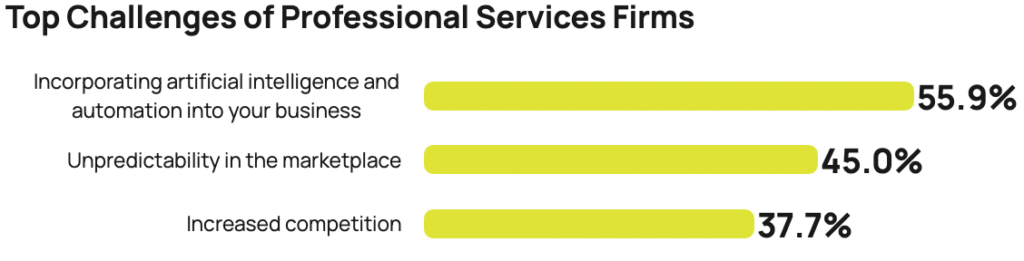
If you aren’t planning for change, you are taking on risk like an open boat takes on water in a storm. One minute you are safely afloat, the next you aren’t.
If your firm relies heavily on referrals, you should make the point that referrals have been in decline for at least two decades. Buyers of services routinely look online for experts who can solve their problems. Many are turning to AI to recommend service providers. If you aren’t where these new buyers are looking, you are invisible.
Now, you need to connect the issue of risk to metrics. Marketing metrics can show you how much risk you are assuming. And marketing strategy is the way you lower that risk and steer your firm toward more favorable waters. By investing in marketing, you aren’t throwing money away. You are guiding the firm’s future.
Even if your goal isn’t growth, marketing gives you more tools to weather a changing marketplace and economic downturns. It can also elevate the perceived value of your services. For example, when you have what we call Visible Experts® on your team, they can often command premium fees. Even better, your firm’s value usually rises with them (this is called the halo effect).
What about the objection around hiring? Marketing is the answer! In fact, it’s probably the only answer. A whole discipline called employer branding has grown up to address this need. But regular marketing can do wonders, too. When your firm becomes more visible and reputable, prospective employees are more likely to find you and express interest in working for you.
Using the framework above, you can help key stakeholders understand what marketing is and why it is an essential tool to mitigate risk and achieve your business goals with consistency. By making reporting on your marketing activities a regular feature of your executive meetings, you can show how they affect real business outcomes. This discipline will build expertise—and confidence in the system.
Marketing costs a great deal of time and money. The most successful firms know this, and they invest twice as much as their no-growth counterparts. Clearly they know something that many firm leaders do not.
Fortunately, it’s never too late to learn.