
The professional services marketplace is recalibrating. After a period of post-pandemic expansion, the median growth rate has cooled to 9.9%—the lowest since 2018. This contraction not only marks the end of “easy growth,” it marks the beginning of a new era. Nearly one-third of firms today believe AI is disrupting their businesses.
In the midst of this tightening and bewildering landscape, however, a select group of High Growth firms is not merely surviving—they are accelerating.
We are thrilled to introduce the 11th edition of the High Growth Research study, the largest ongoing study of its kind. While the past decade witnessed considerable change in digital marketing and business development, one thing remains constant: High Growth firms are able to outperform their peers in almost any business environment.
How We Conducted the Study
To ensure the most accurate snapshot of the industry, the study features insights from 495 firms across a wide variety of professional services industries. Our sample represents almost $85 billion in combined revenue, and hundreds of thousands of employees. These firms represent a global perspective with participants conducting business across six continents.
Five Features of High Growth Firms
At the heart of this study are the High Growth Firms. We examine them to understand what they do differently so that ordinary firms can adopt their strategies and habits. Below are five key takeaways from this year’s study. To see all the findings, you can download the full executive summary for free.
1. High Growth Firms Widen the Investment Gap
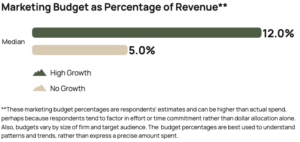
High Growth firms have aggressively increased their marketing investment from 10% of revenue in last year’s report to 12% this year, more than doubling the 5% spent by No Growth peers. This 20% surge may reflect the rising cost of deploying AI and suggests that the “pay-to-play” threshold 2026 has increased in 2026. While struggling firms often minimize marketing as an expense, industry leaders are outmaneuvering them by treating it as a primary growth engine rather than a cost center.
2. High Growth Firms Prioritize In-Person and Online Networking
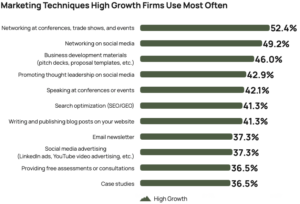
High Growth firms deploy a hybrid networking strategy, prioritizing relationship-building at live events and on social media. These two techniques work together to reach and engage target audiences. These firms not only do a lot of networking, however. They also invest in content and education, using thought leadership, speaking engagements, SEO, and blogging to share expertise, build visibility, and develop a loyal following.
3. Networking, Events, and Brand Awareness Activities Deliver the Greatest Impact
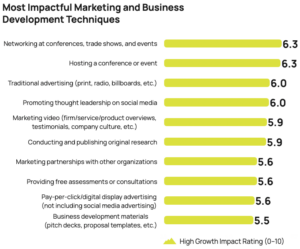
High Growth firms favor a diversified, multi-front strategy rather than a single solution. For the first time, hosting an event appears at the top of the impact list, sharing the limelight with networking at conferences and trade shows. Traditional advertising also surged into the top three, in a tie with social media thought leadership. By blending high-touch events with traditional and digital tactics—including original research and video—these leaders are successfully creating platforms for industry conversation.
4. High Growth Firms’ Interest in AI and Efficiency Grows Stronger
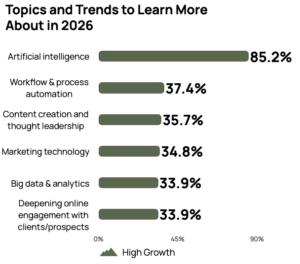
High Growth firms’ interest in AI jumped 63% this year, with 85.2% naming it a top priority for further study. This is followed by workflow and process automation.These two areas of interest suggest that efficiency and productivity are on these firms’ minds. In third place is content creation and thought leadership.High Growth firms recognize that creating thought leaders is a primary engine of growth.
5. High Growth Firms Prioritize Tracking Visibility and Engagement Over Retention
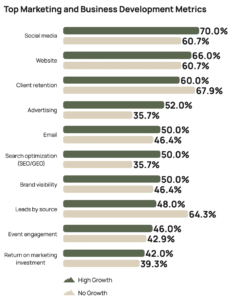
When it comes to marketing metrics, High Growth firms prioritize tracking visibility and expansion compared to their No Growth counterparts. For instance, they are much more likely to track advertising (52% vs. 35.7%) and SEO/GEO (50% vs. 35.7%). While top performers use analytics to optimize outreach and capture new market share, No Growth firms focus on more passive metrics like client retention and lead sources. This data suggests that while struggling organizations are preoccupied with protecting existing business, High Growth firms are interested in learning what works to drive new revenue.
How You Can Use this Data
When traditional marketing tools no longer cut through the fog, you need more than just resilience—you need a new strategy to navigate the obstacles ahead. High Growth firms have already blazed this trail, aggressively investing in the data, talent, and technology required to thrive while others fall back on familiar but outmoded strategies and techniques. By comparing your own habits to the “invest-to-win” blueprint of these high performers, you can identify exactly where your program is on target and where it falls short.
Don’t forget to download the full executive summary (it’s free!). It contains many other insights to inspire your own marketing program and spark changes that can help propel your business forward.

Additional Resources
- The 11th edition of Hinge’s annual High Growth Study explores how the fastest-growing professional services firms achieve exceptional growth and profitability—and how ordinary firms can emulate them. Download the Executive Summary for free.
- Looking for Industry-Specific Benchmarks? Don’t settle for broad averages. Purchase our deep-dive breakout reports for the latest 2026 data on AEC, Accounting, Consulting, or Tech to see exactly where your firm stands against the top performers in your industry.