
If your firm is like most professional services providers, industry conferences represent your greatest opportunity for high-impact lead generation, but they are also a staggering drain on time, money, and emotional energy.
Yet, for too many firms, the approach is less like an event strategy and more like a fire drill.
You leave planning to the last minute. You make decisions on the fly. In the worst-case scenarios marketing leaders only find out a partner had a speaking engagement after they’ve already stepped off the stage. The opportunity to promote it? Gone.
It’s a stressful, chaotic cycle that always traces back to a single point of failure: lots of effort, zero strategy.
Key Takeaways:
- A professional services event strategy creates a repeatable framework for maximizing business development impact at conferences.
- Effective event planning involves a structured four-phase cycle.
- You must research target events and integrate CRM data early to accurately measure event marketing ROI.
- Multi-channel promotion and proactive outreach are essential to establish authority before an event even begins.
- Documenting event processes reduces reliance on individuals and ensures consistent execution across all firm-wide activities.
In professional services, you can’t afford to treat conferences as passive networking mixers. You need to view them as environments where industry conversations are intentionally created. In our 2026 High Growth Study, “networking at an event” and “hosting a conference” tied for the highest-impact marketing tactics of the year. High-growth firms aren’t just attending the party, they’re setting the agenda and positioning their subject matter experts as industry authorities.
To remain competitive, your firm needs to move from accidental attendance to a repeatable, four-phase management cycle: planning, promotion, execution, and follow-up.
Here is how to stop marketing on the fly, and build an event strategy that turns visibility into quantifiable ROI.
Defining a Professional Services Event Strategy
Professional services firms often struggle to measure conference and event ROI because event planning, promotion, and follow-up are handled inconsistently across teams. A repeatable event marketing strategy helps firms improve lead generation, strengthen business development, increase visibility, and create a scalable process for conferences and networking events. Understanding how to build a professional services event strategy allows teams to transition from an approach where they react to situations in the moment to a thoughtful, proactive, revenue-generating model.
The Risks of Ad Hoc Event Planning
- Haphazard, last-minute activities
- Unquantifiable ROI and poor lead generation
- Over-reliance on a few key individuals
The Benefits of a Structured Event Marketing Strategy
- Consistent execution across the whole team
- A repeatable process that doesn’t start from scratch every time
- A formal, four-phase management cycle
The goal is to stop treating events as isolated occurrences and start treating them as a repeatable business process. Any successful strategy requires a procedural document that can flex to meet the needs of every event. You reduce dependency on any single person and ensure the team can execute consistently every time.
Think about the effort required to plan a wedding: six months of work for a one-day event. Now imagine doing that multiple times a year. For firms of a certain size, hiring a dedicated event planner can be invaluable to lead and deliver an efficient, measurable system.
This event marketing guide outlines a four-phase playbook including detailed checklists and five critical optimizations to ensure your next conference is a business-driving success rather than just an expensive trip. Rejoice fellow marketers, as we dive head-first into event planning!
Phase 1: Strategic Planning and Event Logistics
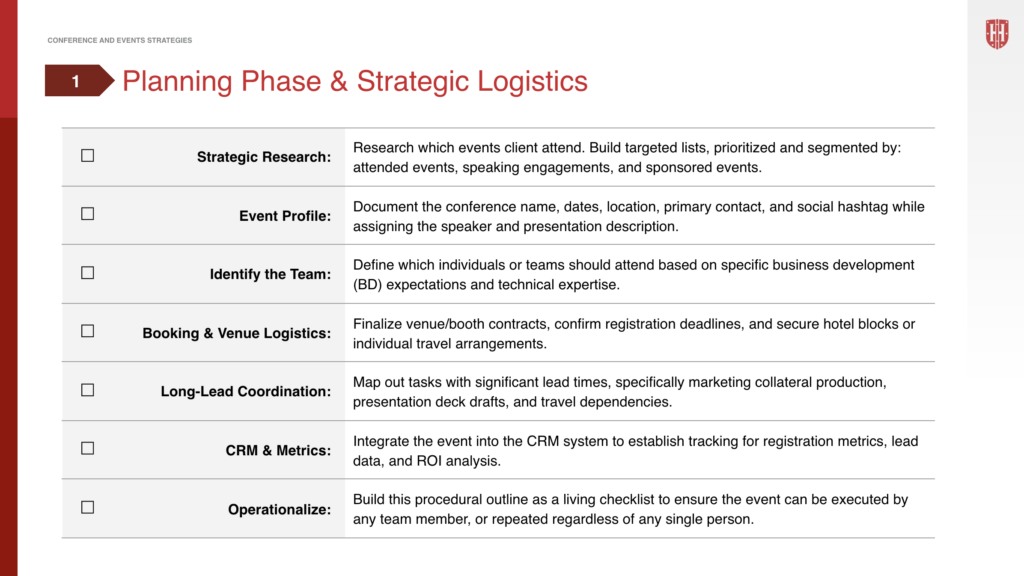
The success of your event marketing is determined during the planning phase, months before the actual conference begins. This phase is about defining goals and locking in long-lead logistics.
Research and target the specific events your clients actually attend. Don’t just pick events because they’re popular. Build target lists segmented by who is attending, who is speaking, and which sessions are sponsored. This ensures you are in the right room with the right people.
Determine which individuals or teams should attend based on specific business goals. Do you need a closer to sign deals or a subject-matter expert to handle technical inquiries? What size team is going to create the level of impact you’re aiming for?
Stay ahead of deadlines, starting with logistics and CRM integration. Map out everything, from marketing collateral to travel. Most importantly, integrate the event into your CRM immediately. If you aren’t tracking registration metrics and lead data before the event, you can’t accurately measure success afterward.
Phase 2: Multi-Channel Event Promotion and Outreach
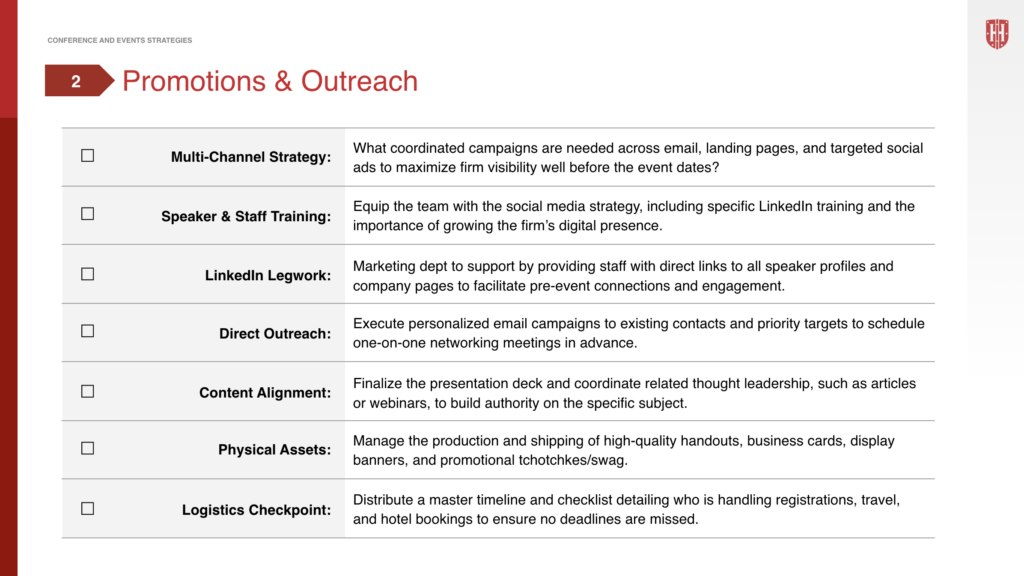
Multi-channel promotion ensures that a firm’s target audience is aware the firm will be in attendance before the event starts. It is also a great opportunity to educate audiences unfamiliar with the firm about its expertise. You need a multi-channel campaign to maximize your reach well in advance.
The marketing department should manage the event LinkedIn strategy to ensure that the team delivers a consistent brand message. LinkedIn management includes providing the team with a clear social media strategy and specific training. A high-impact tactic is to provide staff with direct links to speaker profiles and company pages, making it easy for them to warm up leads before meeting in person.
Direct outreach helps you book one-on-one meetings before calendars fill up. Execute personalized email campaigns to existing contacts and high-priority targets rather than hoping to meet specific individuals on the conference floor.
Content must be aligned with your on-site presence to establish authority. Finalize your presentation decks and coordinate related content, such as articles or webinars, to reinforce the topics you’ll discuss during the event.
Phase 3: On-Site Engagement and Digital Amplification
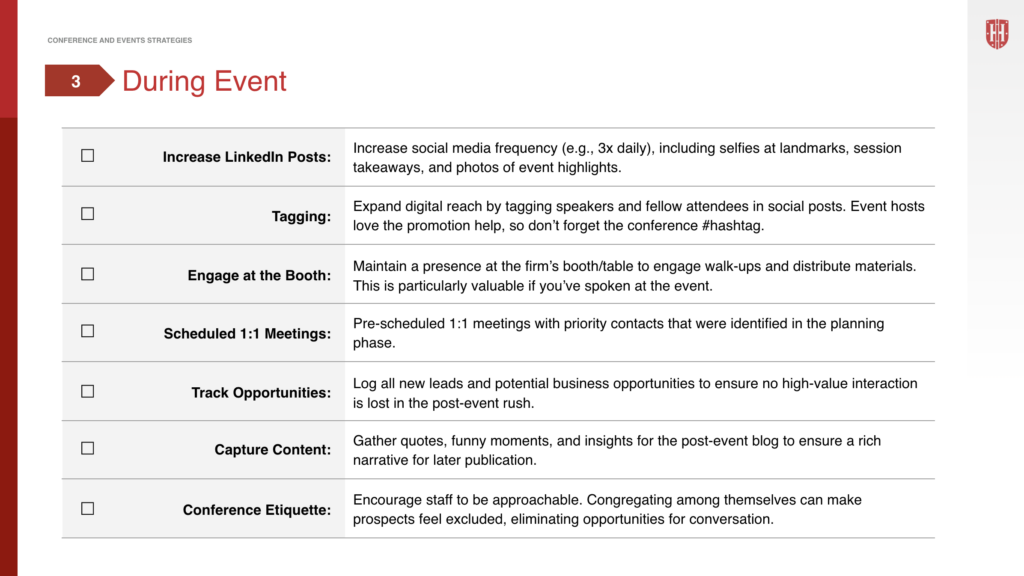
Digital amplification, including real-time social media updates, allows a firm’s reach to extend beyond the physical conference room.
Aim for at least three social updates a day. These shouldn’t just be generic updates—post selfies at landmarks, share session takeaways, and capture photos of event highlights. Always tag speakers and fellow attendees (and don’t forget the conference #hashtag!). Event hosts love the extra promotion, and it keeps you visible to those who couldn’t attend.
Professional booth etiquette is essential for maintaining an approachable presence. Stay active and avoid hiding behind the table or huddling with your own team. Encourage everyone on your team to read the room and remain approachable. When team members have extended conversations with a single attendee, prospects can feel like they’re interrupting, which kills potential conversations.
Don’t just be in the moment, capture the moment. Actively track interactions with prospects to ensure no high-value connections are overlooked. Log all new leads and potential business opportunities immediately. Gather quotes, funny moments, and insights. After the event is over, you can publish these in a blog post.
Phase 4: Post-Event Lead Nurturing and ROI Analysis
Post-event follow-up is the process of converting event momentum into revenue through structured lead nurturing and CRM integration.
Start with the end in mind: How will you report on success?
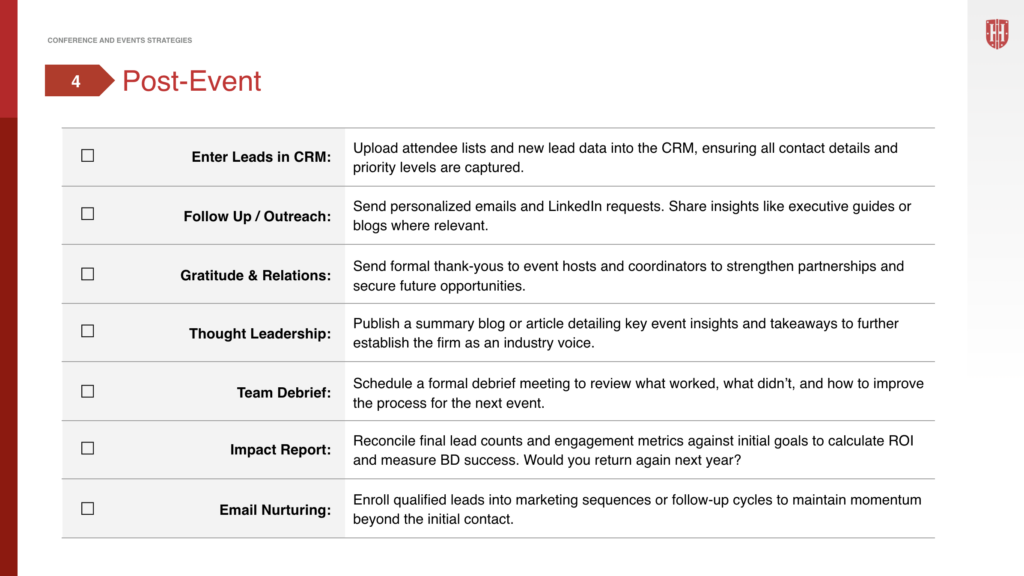
Immediate CRM entry and expressions of gratitude. Upload attendee lists and lead data right away. Send personal thank-you notes to event hosts and coordinators. It’s a simple gesture of gratitude that can strengthen a partnership and may even lead to better speaking slots or sponsorships in the future.
Summarize the event in a blog post and share your expert takeaways. Publish a recap detailing key insights from the sessions. Describe what you found most interesting and how it supports or changes your expert thinking. This kind of post demonstrates your value to firm leadership, provides useful information to internal teams, and educates new prospects who weren’t able to attend the event.
Compare your results against your initial goals. Analyze your lead counts and engagement levels to determine true ROI. Then ask, would we do this again next year?
Five Critical Optimizations for Professional Services Event Strategies
Even a strong playbook has gaps. To truly mature your event operations, consider adding these five elements to your procedural document. Knowing how to build a professional services event strategy involves using these tactical optimizations to improve over time.
- Establish a Dedicated Events Budget: Within the larger marketing budget, Conferences and Events should be a dedicated line item. This allows you to report costs and ROI.
- Conduct a Competitive Landscape Analysis: Don’t just look at clients. Analyze competitor booths, on-site messaging, and marketing materials. Study the overall impact others are creating to find areas for differentiation.
- Develop Unplanned Emergency Protocols: Identify scenarios that require a contingency plan. What happens in the event of travel disruptions, lost shipments, or technology glitches? Having a plan lowers anxiety and sets you up for success even when things don’t go as expected.
- Facilitate Internal Knowledge Transfer: Following the “Team Debrief,” determine if an internal educational session, such as a “Lunch & Learn,” could benefit the wider firm. This allows the attendees to share what they learned with the broader team.
- Manage Personal Logistics: To address a common pain point for staff members, offer clear instructions on per diem policies, approved payment methods, and helpful packing lists. When staff aren’t worried about expenses, they can focus on selling.
By documenting these phases and optimizations, you move your firm away from ad hoc chaos and toward a predictable, high-ROI event strategy. Much of this is highly tactical. Much of it can also be developed in advance and repurposed for future events. Start building (or expanding) your playbook today and take command of your events!
To help your team take a more structured, measurable approach to event planning, we’ve developed an Event Strategy Checklist tailored to professional services firms. It includes key considerations for pre-event planning, promotion, lead follow-up, internal coordination, and post-event ROI tracking.
Download the checklist to help your team plan smarter, stay aligned, and get more value from your next event.
Frequently Asked Questions
What is the most effective way to build a professional services event strategy?
Learning how to build a professional services event strategy requires implementing a four-phase management cycle that covers planning, promotion, on-site execution, and post-event analysis. This structured approach ensures that firms move beyond ad hoc activities, allowing for consistent lead generation, improved ROI tracking, and scalable business development processes across conferences.
How do professional services firms measure event ROI?
Professional services firms measure event ROI by tracking specific metrics such as meetings booked, qualified leads generated, and sales opportunities created. Firms also analyze the impact of speaking engagements and referral relationships, ensuring that every event contributes to long-term business development goals rather than just immediate, short-term visibility.
What is the best way to follow up after a conference?
The best conference follow-up strategies include immediate CRM entry, personalized outreach, and active LinkedIn engagement. Firms should also publish recap content, such as blog posts, to share expert takeaways. This process ensures that momentum is converted into revenue through structured lead nurturing and continuous education for potential new prospects.
Why is event marketing important for professional services firms?
Events are vital for professional services firms because they provide a platform to build authority, strengthen client relationships, and increase market visibility. By hosting or attending industry conferences, firms can position subject matter experts as trusted industry authorities, which accelerates business development and creates high-impact environments for essential industry conversations.
