How has the professional services marketplace changed over the past year? It’s an important question that affects every firm’s plans and expectations for the year ahead.
In a previous post, I described how median growth rates have plummeted more than 4 percentage points in just two years. That’s a 29% decline, and today’s 9.9 growth rate is the lowest in eight years. Whether or not this trend has hit bottom yet is impossible to say, of course. But it’s fair to say that we are in a cautious market—and perhaps one that is continuing to cool.
With this context in mind, I want to examine one chart from the 2026 High Growth Study.
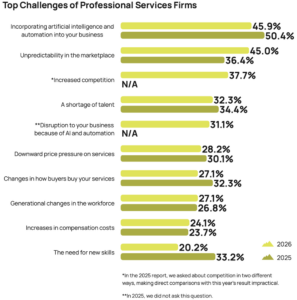
This chart lists the top business challenges identified by our survey participants. It also compares this year’s results with the previous year’s.*
So what do we make of it? Here are my top three takeaways:
1. AI Remains Firms’ Top Business Concern
Artificial intelligence (AI) and automation continue to vex businesses as they try to balance AI’s undeniable power with its significant shortcomings. AI platforms are evolving quickly, with new features and capabilities added on a breakneck schedule. At the same time, AI poses real risks. Hallucination plagues AI-generated answers and content, and firms bound by strict privacy regulations worry that AI could expose sensitive information.
Most firms use generative AI tools for basic tasks such as taking notes, summarizing long documents and drafting text. These are relatively easy to learn and use. But taking AI and automation to the next level involves integrating it into workflows to handle operational tasks, provide deeper insights, inform strategy and improve client deliverables. This stuff is hard and expensive.
This challenge took top honors last year and it holds its position this year, though its dominant position is in jeopardy. That’s because an old hobgoblin is on the rise again: marketplace uncertainty.
2. Uncertain Days Are Here Again
“Unpredictability in the marketplace” rose nearly nine percentage points to nearly overtake AI/automation in the top spot. This is pretty good evidence that the falling growth rates aren’t a statistical blip. With all the political, regulatory and financial volatility we’ve experienced in the past year, there’s plenty for firms to be anxious about.
Uncertainty makes planning for the future—already a fraught exercise—even more difficult. Should you go through with that acquisition? Should you hire those expensive experts? Do you make a move into a new market?
When the marketplace looks like this: ? ? ? ? ?, answering business questions like these becomes doubly hard.
3. The Talent Issue Is in a Holding Pattern
One consequence of today’s economic, technological and political environment is that firms aren’t doing a lot of hiring. Or firing for that matter. The talent shortage hasn’t gone away, but what was once a perennial top-three challenge has drifted into fourth place across the professional services as they kick these concerns down the road.
Not all industries experience this issue the same way, however. Accounting firms, for example, feel the talent shortage acutely as they grapple with an insufficient number of college graduates to fill available openings. For these firms, talent is the second most important challenge today. Meanwhile, the talent shortage has fallen to sixth place in the technology and consulting industries.
Related to this trend is the biggest year-over-year change in the chart. The need for new skills has tumbled 39%, cited by 33.2% of firms in the 2025 report but only 20.2% in this year’s study. While the data doesn’t directly explain this dramatic drop, we can find some clues.
Nine out of ten firms are actively using AI. It is very possible that these tools are making firms’ employees more productive, lessening the pressure to hire new people.
Some leaders may be playing wait-and-see, as well. Almost a third of firms believe their industries are being disrupted by artificial intelligence. With the promise of true agentic AI on the horizon—and the ability to generate sophisticated code from a plain-English prompt already available—many firms may be reluctant to hire or develop skills today that they may no longer need tomorrow.
And as we’ve already discussed, firms also may simply have a new, bigger set of concerns as they find their footing in a boggier, fog-shrouded marketplace.
I hope this walk through some of the challenges faced by firms like yours provides some useful perspective as you adapt to this wind-swept, stormy world. If you feel a little bewildered, you aren’t alone.
Remember, the 2026 Executive Summary also looks at how some firms are growing four times faster than average and generating exceptional profits amid rapid change and chaos. There’s a lot to learn from them. If you haven’t already, be sure to download the free report today.