
The consulting industry is undergoing a significant recalibration, and understanding what separates the top-performing firms has never been more important.
Enter Hinge’s 2026 High Growth Study: Consulting Services Edition.
This specialized industry report moves beyond general trends to uncover the specific strategies, marketing priorities, and operational benchmarks that differentiate High Growth consulting firms from their slower-growing peers.
In an increasingly competitive consulting market, understanding these performance drivers is a prerequisite for sustained success. While the broader market realigns, an elite group of consulting firms is rewriting the playbook.
We have identified five findings from the report that every consulting business should know.
Top Five Findings from the High Growth Study Consulting Report
1. The Market is Slowing Down, But the Best are Growing Fast
Is the demand for consulting services declining? The High Growth Study data shows a multi-year recalibration is underway. The broader consulting market has hit a decade-low growth rate of 8.5%, numbers we didn’t even see during the height of the pandemic.
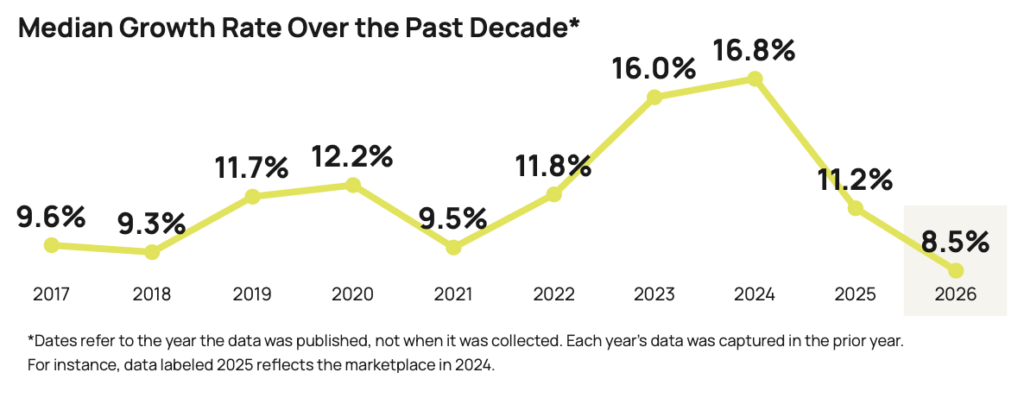
However, an elite group of High Growth Firms is operating in a different reality altogether. High Growth firms are growing at a median rate of 39.9%—nearly five times faster than the average consulting firm, while No Growth firms’ income shrank by 12.2%.
Today’s consulting firms are navigating a triple threat of economic swings, global tension, and technology disruption. This led them to select marketplace uncertainty as the number one business challenge in the consulting industry. The disparity between the High Growth and No Growth firms in the data shows, though, that some companies are handling this uncertainty better than others.
Have High Growth consulting firms transformed market volatility into a competitive advantage? it seems that, rather than retreating into a defensive posture or cutting costs to preserve margins, these consulting firms have doubled down on their visibility and subject matter expertise. They recognize that in an uncertain market, clients gravitate toward the consulting firms that project authority and offer specialized solutions to specific problems. By positioning their experts as the premier voices in their niche, these firms are capturing market share that stagnant firms are leaving on the table. More on this below.
2. Investing in Marketing is a Growth Engine for Consulting Firms
During economic downturns, many consulting companies instinctively pivot to cost-cutting, often misclassifying marketing as a discretionary expense rather than a strategic lever for growth.
This year’s data suggests that this defensive posture may be a critical mistake.
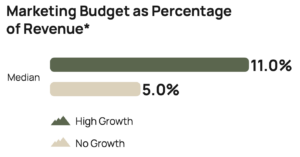
High Growth firms have recognized that the pay-to-play threshold has risen. To break through the noise of a crowded digital landscape, consulting leaders must be willing to out-invest the competition in visibility. High Growth firms allocate a median of 11.0% of their revenue to marketing. To put that in perspective, that is more than double the 5.0% invested by No Growth firms. This is a structural separation that allows High Growth firms to dominate the digital conversation.
Read more: Is Your Marketing Budget Too High?
What is the shape of this investment? Well, High Growth firms have made developing their thought leaders their top marketing priority, followed by securing speaking engagements for said experts. These firms invest in conference sponsorships and get their experts on the floor to network. They also make the necessary investments to equip their experts with a strategy that allows them to develop more content and be more active on social media platforms like LinkedIn.
3. Referrals aren’t enough on their own
Today, a referral isn’t a guaranteed deal; it’s a prompt for a digital audit. If a prospect searches your consulting firm and finds outdated information, broken links, or an empty social feed, a credibility gap opens immediately. Many traditional leads simply will not reach out if your digital presence fails to meet the competition’s standards.
The risk of over-reliance on word of mouth is clear in the data. While No Growth firms depend on referrals for almost half of their business, High Growth firms have lowered that reliance to 37.7%. This doesn’t mean that they value referrals less; it means they are more productive in other categories, such as advertising, events, and digital marketing.
Here’s where the broader consulting industry stands:
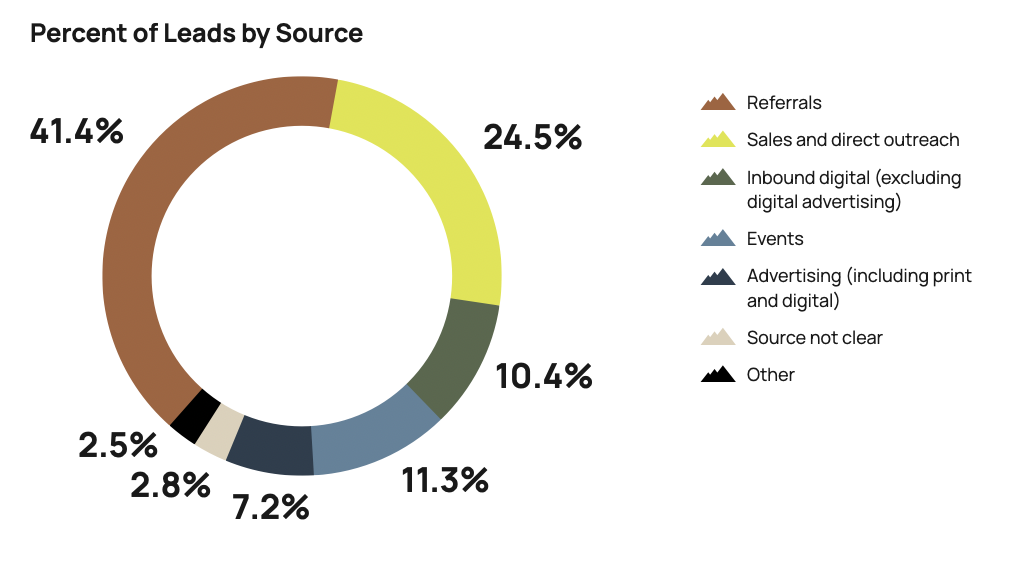 In a consulting market where trust is the primary currency, a lackluster digital footprint is seen as a business risk rather than just a missed opportunity. To bridge this gap, your online presence must serve as a 24/7 validation engine, replacing static websites with a robust ecosystem of social proof and thought leadership. When your digital sophistication matches your real-world reputation, you stop being a placeholder and start being a partner clients can trust.
4. Consulting Firms Should Host Their Own Events
In the current consulting landscape, hosting events emerged as the ultimate “secret weapon” for High Growth consulting firms, offering the best return on effort of any marketing technique measured.
While the industry has leaned heavily into digital channels, High Growth firms are also driving results through interpersonal and reputation-building activities, with networking at events becoming the most widely used technique at 60.8%. By hosting exclusive events, consulting firms transform the sales process from a series of pitches into a high-touch, relational experience where prospects can see your expertise firsthand. It is the most efficient way to scale trust and let your success stories do the selling for you.
The High Growth Study Consulting report shows that “hosting your own event” achieves the highest efficiency rating of 0.91. It’s followed closely by public speaking and website-based blogging. Although digital outreach is important, the study suggests it is time to reintroduce face-to-face engagement to anchor an environment where relationships and revenue grow in tandem.
5. Embrace Artificial Intelligence
With over 95% of consulting firms using Artificial Intelligence (AI) for routine tasks such as note-taking and market research, AI adoption has become nearly universal. However, a stark divide has emerged in how that technology is applied.
For No Growth firms, AI remains a peripheral convenience used primarily for drafting emails or minor administrative tasks. In contrast, 85.2% of High Growth firms have elevated AI to a top strategic priority. Rather than treating it as a digital assistant, High Growth firms are embedding AI into their core operational functions to overhaul service delivery.
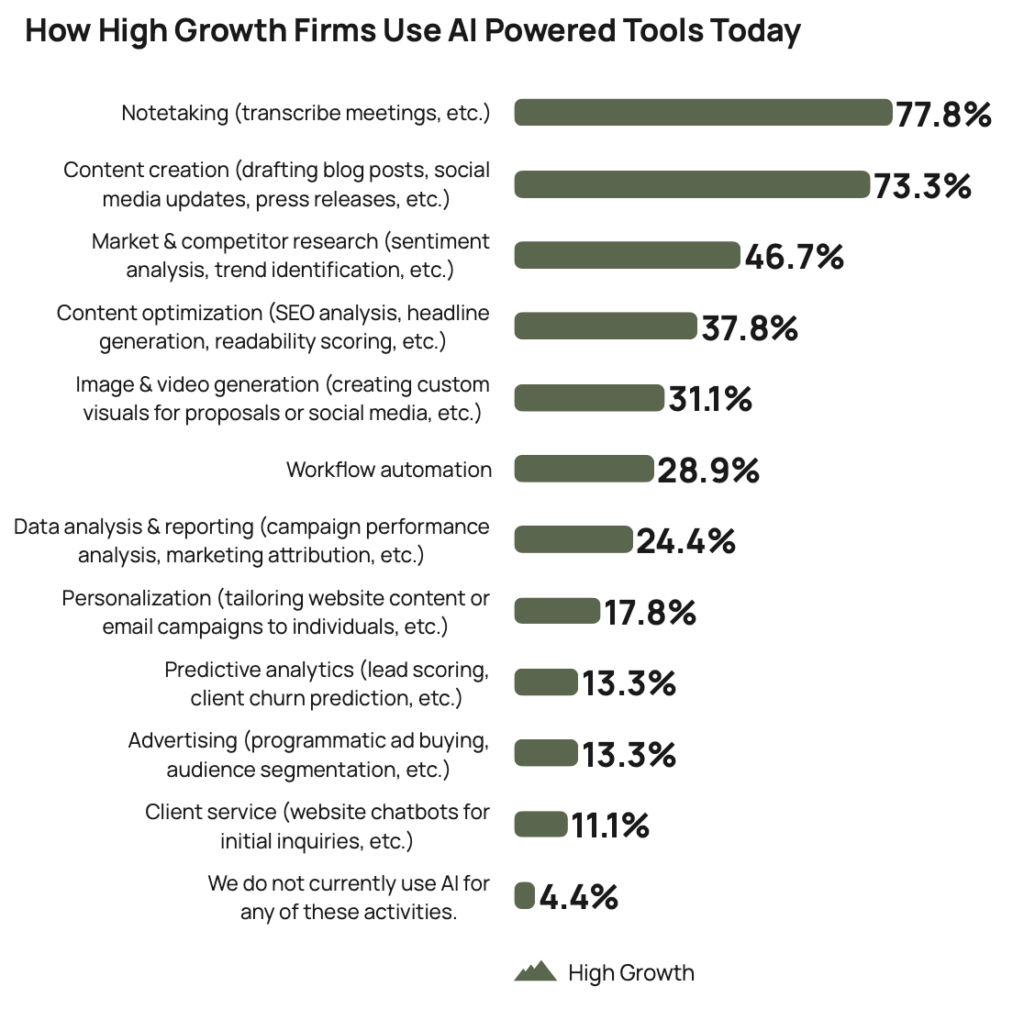
This transition from “AI curiosity” to “AI integration” allows High Growth firms to operate with a level of speed and profitability that traditional models simply cannot match. In the current consulting landscape, the competitive advantage belongs to those who use AI strategically, not just to those who use it to save a few minutes on a task.
Key Takeaways
High Growth Firms Outperform: High Growth consulting firms grow nearly five times faster than the average, outpacing No Growth peers.
Marketing Investment Drives Success: Allocating more revenue to marketing enables High Growth firms to dominate digital channels and thought leadership.
Digital Presence is Essential: Referrals alone are insufficient; a strong online footprint validates credibility and supports growth.
Events Build Trust: Hosting events delivers the highest marketing efficiency, fostering relationships and accelerating client acquisition.
AI Integration is a Differentiator: Strategic use of Artificial Intelligence transforms operations and drives sustainable competitive advantage.
Conclusion
The data is clear. The differences between High Growth and No Growth Firms are about strategy. The firms thriving today are those treating marketing as an engine rather than an expense.
Purchase the full 2026 High Growth Study: Consulting Services Edition to gain the complete study and ensure your firm stays on the right side of the growth curve.
FAQ
What is the High Growth Study Consulting report, and why is it important?
The High Growth Study Consulting report is a specialized analysis of the consulting industry, highlighting strategies and benchmarks that set High Growth consulting firms apart. It provides actionable insights for firms seeking to outperform competitors.
Where can I access the High Growth Study Consulting report findings?
You can access the key findings and detailed benchmarks by purchasing the High Growth Study Consulting report, as well as reviewing the major insights summarized in this article.
How can consulting firms implement recommendations from the High Growth Study Consulting report?
Consulting firms can implement recommendations by increasing marketing investment, enhancing digital presence, hosting relationship-building events, and strategically integrating Artificial Intelligence into core operations. But a strategy is key and working with a teaming partner like Hinge who understands your industry can help your team get there faster.
How does the High Growth Study Consulting report compare High Growth and No Growth firms?
The report compares High Growth and No Growth consulting firms by analyzing growth rates, marketing priorities, digital strategies, and AI adoption, offering a clear framework for firms aiming to achieve sustained growth.