
What worries you most?
Last fall, we asked 495 professional services firms what they were most concerned about in the coming years. Increased competition was one of the challenges they mentioned most often—coming in third, behind AI and an unpredictable marketplace.
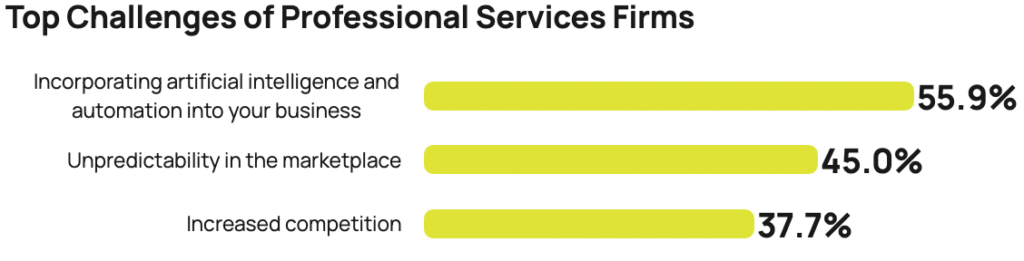
Source: 2026 High Growth Study
This competition is coming from multiple angles. Nimble upstart firms with fresh, bold ideas and disruptive business models are giving buyers new options to consider—sometimes at lower price points. At the same time, the biggest players in the field are investing heavily in technology and top talent, making it difficult to compete at the market’s high end. Meanwhile, PE firms and expansion-minded businesses are investing in M&A, consolidating many mid-market players to create deep, multi-faceted organizations.
So it probably makes sense to get to know your competitors. As I’ve explained before, you likely don’t know them as well as you think. In fact, there’s a very good chance you only know a fraction of the firms you compete against.
But how exactly do you learn about the competition?
How to Conduct a Competitor Analysis
The first step is to uncover the full spectrum of organizations that your prospects consider when selecting a service provider. A typical firm is aware of only a quarter of its competitors.
How do you do that? You ask your clients.
Conduct a simple survey of 10-30 clients (the more, the better). Ask them who they consider your competitors. Then ask them what they believe each firm is known for and how they believe your firm compares to them. This second part should be open-ended so they can answer in any way they want. At the same time, send the same survey to your business-development and client-facing staff. You will almost always be surprised by the breadth of companies your clients list, many of which you may never have heard of.
Next, identify your top competitors. Compare the names that your team supplied against those listed by your clients. Which appear most often? To keep the rest of this exercise within reasonable bounds, try to narrow the list to three to five top competitors. Chances are, these will be familiar firms, but there might be a surprise or two in the group.
Now it’s time to dig in and learn about them. If you want a detailed understanding of what you are up against, here some things to look for:
Strategy: How is the firm positioning itself in the marketplace? Does it have a unique specialty, focus, or point of view? What big messages are they conveying about their business? Look for this information on the firm’s website. Check their homepage title tag (the text that often appears when you place your cursor over the browser window tab), the headlines and introductory text on their homepage and their About page. Keep in mind that many firms are poorly positioned and have little or no differentiated messaging.
Salient Questions: Is your firm sufficiently differentiated from your competitors? Do buyers have a compelling reason to choose you over other firms? Have you articulated that reason clearly?
Key Services: Check the firm’s website for the services and products they offer. Compare them to your own offerings. The point is not to imitate your competitors. Instead, the goal is to understand how the market may be changing and what kinds of offerings buyers are encountering as they compare firms.
Salient Questions: Are you missing any new or important services or products that today’s buyers want? Are there any offerings you could drop? Can you tailor your offerings in a way that sharpens your positioning?
Branding: Pay attention to your competitors’ visual brands. Does their logo, color palette, photography, and design distinguish them in the marketplace? Does their branding convey sophistication and position them as a premium option?
Salient Question: Is your visual brand helping or hurting your business?
Website: Bring up each competitor’s website. Now get ready to ask a fistful of questions. Does it load quickly? Is the experience as good on a phone as it is on a laptop? Is the look and feel modern, sophisticated and appropriate to the firm? Does the site look different from other firms in the industry? Is it easy to navigate? Is it easy to read? Are the services presented in a compact, logical way, or are they a sprawling, mind-numbing list of a-la-carte services? Is there an on-site blog? Is it updated often? Are the articles educational or self-promotional? Are there clear calls to action? Is there a library (or equivalent) section? Does it include a mix of free and gated (requires filling out a form) material? Are there offers throughout the site that promote some of this thought leadership material What is their Domain Authority (or similar metric)?
Salient Questions: Does your website clearly convey what makes your firm different? Is it easy for visitors to find key information? Is it authoritative enough to attract new prospects through online search? Is it built in a way that you can generate leads and nurture them over time?
Traditional Search: Over the past few years, Google made fundamental changes to its search engine, which had a dramatic effect on website organic search traffic. But SEO is far from dead. It remains an important way that people discover thought leadership content and other website pages. How does your SEO performance compare to that of your rivals? Pay particular attention to visibility metrics such as monthly organic search traffic, referring domains and number of backlinks. Then look at their top keywords, how they rank in Google, what pages they link to and how much traffic they produce. What proportion of these keywords are organic (that is, don’t contain the firm’s name) versus branded?
Salient Questions: Are people who are interested in expertise like yours finding your blog posts and website? Are they steadily turning into clients?
AI Search: AI search is a rapidly growing segment of online search. It can generate high-buying-intent leads. You can use tools like SEMRush and OtterlyAI to capture metrics like how often competitors are mentioned in AI answers, how often they are cited as sources, which AI engines are their best performers, their top prompt themes, top cited pages and where they stand on the AI search maturity scale (low to high).
Salient Question: Are you set up to succeed in AI search?
Paid Advertising: It is no secret that firms can no longer rely on SEO to drive their marketing strategy. Many firms are turning to paid digital advertising, especially on Google and LinkedIn, to fill the gap. Using tools like Semrush, Ahrefs or Google Ads’ Keyword Planner, you can see what keywords your competitors are ranking for and (in some tools) even the ad text they are using.
Salient Question: Do you need a paid advertising program to compete in today’s marketplace?
Earned Media: Using specialized tools such as Meltwater or Muckrack, you can see how often each competitor is mentioned in the media. You can also determine where they are being featured and what kinds of topics are receiving coverage. These insights help you determine how visible your competitors are and what they are best known for. AI search platforms also look to earned media for signals that a firm is an authority in its industry.
Salient Questions: Do you have an earned media strategy? Is it working?
Visible Expertise®: How visible are your competitors’ experts? And how much thought leadership content do they generate? Begin by examining each firm’s team or leadership pages. Do their bio pages describe their speaking and or publishing experience? Do they link to blog posts or articles on or off the site? Go to the blog. Are posts regularly authored by firm subject matter experts? Are the posts well written, educational and unbiased? Is there other educational content on the site (such as webinars or courses) that both educates and exposes visitors to individual experts? You can also use PR tools (see Earned Media above) to identify media mentions and publications.
Salient Question: Are your top experts producing and delivering content in a way that raises their visibility to your target audience?
Social Media: How active and visible are your competitors on social media? Using tools like Sprout Social or Semrush, you can track a variety of social media activities, such as number of followers on each platform, what content is performing best, levels of engagement and whether clients are saying positive or negative things about each firm (sentiment). How are your competitors using social media? Do they appear to have a strategy?
Salient Question: Is social media building your firm’s credibility, visibility and trust? Is it helping you achieve specific strategic goals, such as networking, sharing content or recruiting?
If doing a comprehensive competitive assessment like this sounds like a lot, you can always scale it down. A little intelligence is far better than none. The point is that you should build the habit of relying less on anecdotal evidence or assumptions that may be out of sync with the marketplace.
Of course, you can always hire a firm or consultant to conduct an in-depth competitor analysis for you. We’ve learned that the fastest-growing firms not only track more metrics, they outsource more skills than their slower-growing peers. If you really want to understand how your firm is doing against key rivals in each of the areas and channels above, a deep-dive competitor review like this can be a worthwhile investment. If, however, you aren’t quite ready to take that step, there’s plenty you can do on your own.