
One of the most remarkable findings in the 2026 High Growth Study is captured in this chart:
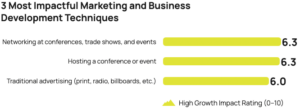
These are the three marketing techniques that high-growth firms* identified as having the most impact on their business.
In-person networking. Hosting an event. Traditional advertising.
Wait. Are we Marty McFly? Have we travelled back in time? In this age of AI, are billboards and tradeshow booths really the future of marketing?
Now, I admit that I have engaged in a little selection bias here. In fact, a digital marketing technique—promoting thought leadership on social media—shares third place with traditional advertising. And that is followed on the list by marketing video, another digital technique.
But that doesn’t change the point I want to make. Of the top ten most impactful marketing techniques used by high-growth firms, seven are old-school activities like marketing partnerships and providing free consultations. (Download the research report for the full list.)
And this isn’t a new trend this year. Traditional marketing techniques have long dominated this list. Last year, for instance, eight of the top-ten high-impact activities were traditional. The year before, five out of five were. When I use the term “traditional,” I mean techniques that firms were using before there was even an internet.
A vast array of digital marketing tools are available to professional services marketers. And our research shows that the best-performing firms deploy a roughly balanced mix of digital and traditional techniques. So why does this list of those that deliver the best results skew so heavily to the traditional side?
Clearly, these techniques are resonating with prospective clients.
Perhaps in a world in which prospects’ email inboxes get more difficult to manage every year and digital ads are everywhere online, more personal marketing makes an outsize impact. Maybe prospects like meeting the firms and professionals they might hire, getting to know them in a way that many digital techniques can’t deliver.
I think there is some truth to those explanations. But I believe there is a lot more to the story.
Professional services are by their nature people-based businesses. They have an inherent bent toward interpersonal interactions. These are tried and true ways to establish trust, build relationships and close deals. At the same time, these traditional techniques come with real limitations. You can only meet as many prospects as your time allows. And your reach is constrained by the number of places you can travel.
To some extent, traditional advertising and public relations address the problem of reach, but they aren’t great at eliciting trust. They can tell a lot of people what to think, but they can’t make them actually believe it.
High-growth firms recognize these limitations. That’s why they spend twice as much on marketing as their slower-growing peers. They are investing in a wide range of traditional and digital techniques that not only expand their reach (like advertising) but build trust (like content marketing). Not all of these techniques show up on the top-10 impact list, but each one contributes to the success of the activities that do make the list.
In other words, the items on this list get the credit, but a host of interconnected tactics support them in the background. Let’s take one example: networking at conferences. Before, during and after the conference, a firm’s marketing team might use social media to encourage people at the conference to reach out to their attending experts. They may use social media advertising to promote a speaking event or breakout gathering they are leading. Their email newsletter might include an article related to the conference theme—and let readers know members of the firm will be there. All of those activities make the networking or speaking opportunity more visible, more resonant and more powerful.
Another factor is that many of these so-called traditional techniques have evolved for an online world. For instance, hosting a conference—number two on the list—could be a physical gathering of people. But it could just as easily (or more easily) be a virtual assembly. Even if it were held at a physical location, you might offer remote access for individuals who can’t attend in person.
To further make this point, free consultations (tied for seventh on the list) often happen over video conferencing software. And most of today’s business development materials (tenth) are digital documents delivered by email or uploaded to a secure portal.
Professional services marketing and business development will always be focused on making personal connections. Even if we wake up one day and find AI agents doing large parts of our jobs, those agents are ultimately serving people. And those people will be selling those services to other people (clients) who need them.
Will this list ever be dominated by digital techniques? Maybe. But only if those techniques build bonds between people that can be attributed to business growth.
*We define high-growth firms as those that have a compound growth rate of at least 20% for the past three-year period. This group significantly outperforms the rest of the field when it comes to growth and profitability.