
Immaturity isn’t just for kids anymore. Plenty of otherwise serious-minded professional services firms, even successful ones, are in on the act.
Now, before you pack your teeth with spinach or ask if I like “see-food” (I have 3 boys), I have to tell you that I’m talking about digital immaturity. My apologies to the young at heart.
I’ve commented briefly on this chart before, but today I think it deserves a deeper look:
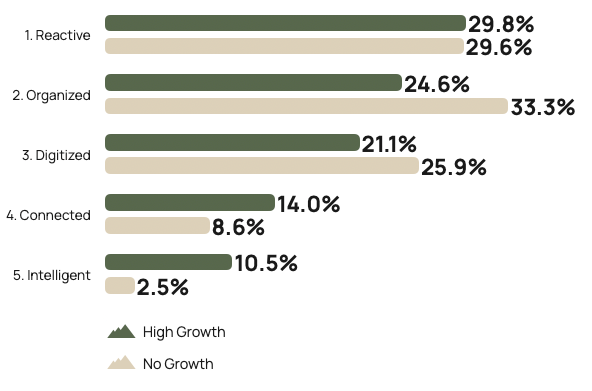
This chart compares high-growth firms (green bars)—those that experience at least 20% compound annual growth over a three-year period—against no-growth firms (beige bars)—those that experience zero or negative growth over the same period. It also divides each growth category into five digital maturity levels. If you are interested, you can read what each signifies in the 2026 High Growth Executive Summary. But for our purposes, you just need to know that the numbered levels represent an increasing scale of sophistication, from rudimentary (1) to highly advanced (5).
What can we take away from this data?
Almost one in three of all firms rated themselves in the lowest level of maturity. Over half of firms, including those in the high-growth category, fall into the two lowest levels. And when you move up another rung, three-quarters of high-growth firms and 89% of no-growth firms sit in the first three levels of digital maturity.
That’s a shockingly bottom-heavy distribution.
Slightly less than a quarter of high-growth firms and about one in ten no-growth firms have reached the top two levels. In a business world that talks incessantly about technology, especially AI, this seems like a dismal state of affairs.
When I looked at the results for each of the individual industries we covered in the study, one set of data looked different. Its chart was a classic bell curve, with most firms clustered around the center. This was, unsurprisingly, the technology & software industry.
No technology or software high-growth firm gave themselves a Level 1 rating, while 14.8% placed themselves in Level 5—that’s a 50% improvement over the aggregate, all-professional services number.
This means that if you are in any other industry, the results in the chart above are skewed slightly higher because of the technology and software firms in the sample. Meaning your industry is likely worse off than the data shown.
In a marketplace pushing a highly connected, automated, AI-superpowered tech stack, most firms are falling woefully short. Many firms remain stubbornly stuck in the paper-and-spreadsheet age.
There is a paradox in these numbers, of course. While the high-growth cohort grows four times faster and is much more profitable than their no-growth peers, they follow roughly the same digital maturity pattern as the rest of professional services. Yes, their maturity numbers are better (especially at the high end), but they tell more or less the same story as everyone else, with about one in three bottomed out at Level 1.
If 75% of the best-performing firms are absent from the top two levels, then how much of a role does technology really play in their success?
It’s a tricky question. The easy—and very likely wrong—conclusion is that there is little correlation between digital maturity and high growth, so technology is not an important factor in firm growth.
We believe the answer is more subtle. And it has as much to do with human psychology and the pace of technological change as it does with what tech platforms a firm employs.
My colleagues at Hinge have noticed that a “reset” has taken place in these numbers over the past couple of years. Digital maturity used to be generally higher across the board, then around 2023–2024 they abruptly fell. Based on the timing of this decline, we believe the emergence of AI was the major culprit.
All of a sudden, the bar of technological sophistication rose to a towering new height, and everybody was standing at ground level looking up, trying to figure out how in the world they would clear it. Even today, most firms are still trying to understand how and when to use AI.
When asked to assess their digital maturity, firm leaders and marketers seem to believe they are now playing a different game, one whose rules they are still trying to understand. This seems like the most plausible explanation for today’s lower high-growth digital maturity numbers.
That said, we continue to believe that high-growth firms are better at deploying, integrating and using technology than this chart indicates.
Why do we think this? Because their numbers were higher before the Big AI Bang, which occurred in November of 2022 when OpenAI released ChatGPT 3.5. These organizations were better at connecting disparate platforms, training their teams on the software and using its advanced features.
Even if all the fastest growing firms haven’t yet mastered AI, many of them still have a strong lead over their slower-growing peers when it comes to using technology to improve efficiency and provide real-time insights. But when we ask them to rate their digital maturity, they give themselves only partial credit because of their AI deficit.
So by one measure, the difficult-to-attain ideal of multiple connected AI-driven technology platforms, most professional services providers are immature. Even if they aren’t telling Uranus jokes.
By a different measure, one that includes powerful process automation and tech that today seems so 2022, high-growth firms have a decided advantage. And if you look again at the chart above, you’ll see that the fast-growing group also significantly outperform their no-growth counterparts in the top two levels.
There are many factors that contribute to high performers’ success. Technology is one of them. But it sometimes takes a careful reading of the data—and some historical context—to see the story.
How does your digital maturity stack up against the fastest-growing firms?