
Are you marketing backwards? Let me ask this question another way: Are you deciding what techniques and tools to use rather than asking—and answering—the more important questions first?
Hinge’s annual High Growth Study uncovers what techniques the most successful professional services firms use to outperform their peers. As valuable as those insights are, they aren’t enough.
Every firm’s clientele is different. As a result, their behavior may be different, too. They may respond to different marketing strategies, read different publications or online resources, attend different conferences or be more or less inclined to search for new service providers using Google and AI than other firms in your industry.
Until you understand how your buyers behave, you can’t really build a marketing program with confidence.
Now, you may think you understand your buyers. After all, you work with them every single day. But chances are, you don’t. Their habits and preferences change. And our research shows that you know less—a lot less—about them than you think.
Consider the chart below, which represents interviews with hundreds of firms and thousands of their clients. When we ask firm staff who their competitors are, then ask their clients who they consider competitors of the firm, there is just a 25% overlap on average between the lists!
Buyers’ and Sellers’ Competitor Lists Show Minimal Overlap
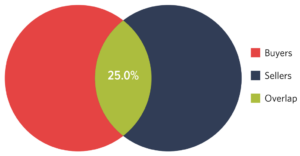
Source: Hinge Inside the Buyer’s Brain study
So what do you do about this situation? The answer is to conduct research on your target audience. Audience research is the best way to learn about how your clients and companies like them find, assess and select a firm like yours. It is also the only way to find out why they selected you over the competition—and why, in many instances, they continue to use your firm.
Research provides a wealth of insights that touch every aspect of your organization. And the way it can help marketing make smarter decisions is pretty remarkable. When you can get a handle, however imperfect, on the way your buyers think and behave, you are able to evaluate where you invest your limited dollars and time. Having this information can be such a revelation, and a lucrative one at that.
Beyond formal audience research, tools like SEMRush, Sparktoro and Meltwater (to name just a few) can help you understand where your audiences spend their time online, what they read, what topics they are interested in and what events they attend. This data can not only validate your traditional research findings, but also provide new ideas to test.
Most firms today don’t have access to accurate information like this. Instead, they rely on anecdotal evidence, gut instinct and memories of what seemed to work in the past, though they often lack the hard data to know for sure.
How well do you know your audience (and how certain are you that you are right)? And is your marketing program based on the way your buyers behave rather than the biases you bring to it?
Your success may depend on how you answer the tough questions.