
How do the most successful accounting and financial services firms achieve significantly higher growth and profitability than the industry average? And how do they do it year after year?
These are the questions we’ve been addressing for over a decade in our annual High Growth Study. Since we began this one-of-a-kind research project, we have tracked the evolving marketing strategies of the best-performing accounting and financial services firms. The 2026 High Growth Study: Accounting & Financial Services Edition reveals key factors that separate the industry’s fastest growing firms from their slower growing peers.
Today, we share a few of the most compelling insights from this year’s study. You can purchase the full research report here.
Meet the Fastest Growing Accounting & Financial Services Firms
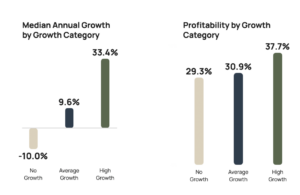
Today’s accounting and financial services firms are beset by a host of pressures, such as incorporating AI and automation, a critical shortage of talent, increased competition, and generational changes in the workforce. At the same time, the median growth rate has fallen to 10%—the lowest point in five years.
Despite these challenges, an elite group of firms have achieved remarkable performance. These High Growth firms achieve a minimum of 20% compound annual growth over a three-year assessment period.
High Growth firms grow 3.5 times faster than average firms. Furthermore, these top performers are more efficient, enjoying a profitability of 37.7%—making them 22% more profitable than average growth firms.
What strategies and techniques are propelling superior growth in these accounting and financial services firms? How do they navigate the complexities of today’s market? Let’s explore some of the key insights uncovered in this year’s study.
Finding 1: High Growth Firms Invest Almost 2X More in Marketing
While the broader industry invests a modest 5% of revenue in marketing (not including compensation), High Growth firms are spending almost double that rate.
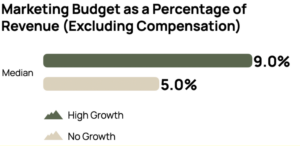
High Growth accounting and financial services firms invest 9.0% of their revenue in marketing. This represents an 80% increase in spend for the High Growth group compared to last year’s report, perhaps reflecting the capital intensity of a modern, AI-driven marketing strategy. Firms attempting to compete with lean budgets are being outmaneuvered by competitors with more to spend.
Finding 2: Developing Thought Leaders is a Top Priority
When we asked participants about their marketing priorities for 2026, the High Growth cohort produced a balanced list of traditional and digital techniques. The chart below shows the top three. Social media marketing leads the way (37.5%), and developing thought leaders is tied for second place (28.1%).
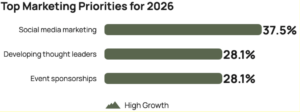
High Growth firms understand that their expertise is the most powerful marketing tool they have. They actively cultivate thought leaders—what we call “Visible Experts®“—to set themselves apart, expand their reach, and increase the perceived value of their services. Savvy firms remove the friction between experts and the marketplace by actively supporting their thought leaders and grooming them to become engines of business development.
Finding 3: Personal Engagement and Thought Leadership Produce the Greatest Impact
High Growth firms demonstrate a clear understanding of the need for a multichannel approach. They also prioritize what works. While digital marketing remains essential for building visibility, human-centric activities top the list of most impactful marketing and business development techniques.
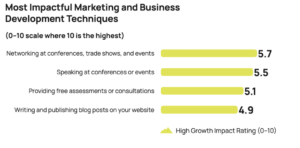
The best-performing firms rely on a roughly 50:50 balance of traditional and digital marketing strategies to outcompete their challengers. The chart above shows the top four techniques (see the full report for the full list). Today’s High Growth firms are using a combination of in-person activities, thought leadership and digital techniques to build visibility, trust and prestige.
Finding 4: The High Growth Advantage in Research
One of the longest-standing findings of our study is that High Growth firms are more likely to conduct formal research. This year, 78% of High Growth firms reported conducting regular research to guide their strategy.
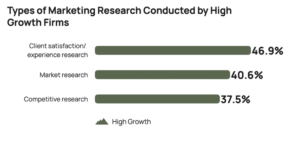
High Growth firms demonstrate a commitment to understanding their audience across multiple categories. The three most common types of research are:
- Client satisfaction/experience research: Used to gauge service delivery and referral likelihood.
- Market research: Used to identify hidden opportunities and understand buyer needs.
- Competitive research: Used to sharpen firms’ messaging and identify service gaps.
By turning research into a strategic advantage, these firms make data-driven decisions that drive growth and enhance client relationships.
Finding 5: Most Firms Struggle with Marketing Data Mastery
A confounding finding in this year’s study is the widespread challenge across all growth categories to capture and use marketing data.
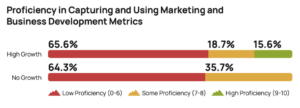
Almost two-thirds (65.6%) of High Growth firms rate their proficiency as “low,” a sentiment shared by 64.3% of No Growth firms. While High Growth firms hold an edge at the highest level of proficiency (15.6% vs 0%), the broader message is that most firms lack the skills or discipline to track performance effectively. This finding suggests there is a tremendous opportunity for firms that can become proficient in using marketing. Even small steps could provide insights that most of your competitors lack.
Go Further. Purchase the Full Study.
These findings offer a glimpse into the strategies of the fastest-growing accounting and financial services firms in 2026. The full 2026 High Growth Study: Accounting & Financial Services Edition provides a comprehensive analysis of what drives success in today’s market, from AI adoption to M&A trends. Ready to dive deeper and unlock the secrets of high growth? Get the full report here.
