
The technology and software industry is undergoing significant recalibration. Following a brief post-pandemic boom, the median growth rate has fallen to 10.6% – the lowest recorded in eight years. Organic growth is increasingly difficult to achieve as firms face heavy competition fueled by disruptive AI startups, large firms that continue to add new markets and services, and shifting regulations.
Yet High Growth Firms are defying these trends. These top performers reported a median growth rate of 41.3%, outpacing the industry average by a factor of 4.3. They are also 86% more profitable.
How do they achieve these results in a cooling market? Here are five key highlights from the Hinge’s 2026 High Growth Study, Technology & Software Edition.
1. High Growth Firms are Spending More on Marketing
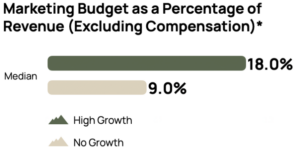
While many firms are tightening their belts in a cooling market, High Growth technology and software firms are aggressively investing in marketing. These top-performing organizations invest 18.0% of their revenue in marketing – double their No Growth peers. This is an 80% increase in spending over the previous year, which may reflect the capital intensity required to maintain a modern, AI-driven marketing program.
High Growth firms are deploying this capital strategically. In fact, “marketing technology, AI, and automation” is their top marketing priority. They are more than twice as likely to prioritize these tools than their No Growth counterparts. This is likely because they recognize they are essential to thrive in a marketplace increasingly dominated by disruptive AI-powered competitors. By integrating these technologies into every aspect of their business, they seek a strategic advantage beyond simple efficiency.
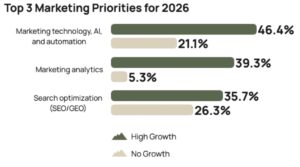
The true differentiator for these firms lies in their ability to use these tools to capture deep-level insights. High Growth Firms are 7x more likely to prioritize marketing analytics, using AI to drive strategy, predict client needs, and tailor experiences at scale. By mastering marketing tech, automation, and data automation, they are able to counteract marketplace uncertainty and build a sustainable competitive advantage.
2. High Growth Firms Love Video
For the first time, video production tops the list of skills High Growth technology and software firms outsource most often. Over 60% of top performers now tap external specialists to execute their video production. Likely, they recognize that high-quality video is a specialized craft best handled by experts.
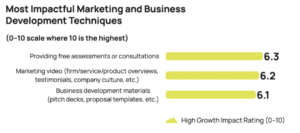
Video also is ranked as the second most impactful marketing technique used by High Growth firms. Increasingly, people are choosing video over reading text to learn about firms and their products and services. Video is also an important source of information for AI and traditional search results. High Growth firms know this and are investing accordingly.
3. Relationships still drive Business Development
Despite the rapid proliferation of AI and digital tools, the technology and software industry remains deeply human-centric. Personal interactions still drive the majority of new business. High Growth firms recognize that building human connections is the most efficient way to develop new clients They understand that by giving prospective buyers access to their experts, those potential buyers will be more likely to trust the organization as a whole.
A primary vehicle for building this trust is the use of free assessments or consultations, which High Growth firms rank as their most impactful marketing and business development technique (see figure above). These sessions allow firms to interact directly with buyers at the exact moment they are selecting a product, offering prospects a low-risk way to experience the firm’s expertise firsthand. Because these consultations can play a critical role in nurturing late-stage prospects and closing business, they deliver a superior return on effort despite the considerable time they demand of high-value employees.
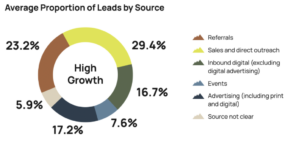
Human marketing activity is the primary source of leads. If you combine sales and direct outreach (27.2%), referrals (23.8%), and events (12.4%), nearly two-thirds of the industry’s total lead volume results from direct or indirect human interactions. To capitalize on this, High Growth firms actively encourage key members of their team to become Visible Experts®. By supporting these thought leaders, firms establish a pathway for prospective buyers to become loyal followers of their top experts.
4. Search Optimization Is High Growth Firms’ Most Frequently Used Marketing Technique
Search optimization is High Growth firms’ most widely used marketing technique, with nearly two-thirds of top performers employing it on a regular basis. By prioritizing search, these firms ensure they remain visible to prospective buyers who are actively seeking specialized expertise to solve complex business challenges.
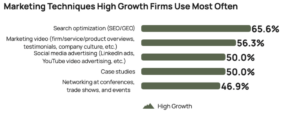
To prepare for a future in which much, if not all, search is handled by AI, High Growth firms are expanding beyond traditional SEO practices to also address emerging AI search technologies. Generative engine optimization (GEO) is the subdiscipline devoted to this speciality. While SEO is far from dead, savvy organizations are optimizing their content and web pages for online search today and tomorrow.
5. High Growth Firms Are Better at Using Data
High Growth firms are data-driven and far more proficient at using marketing metrics than their slower-growing peers. These top performers rely on objective data to determine the effectiveness of their marketing programs, equipping them to act on insights in a timely manner.
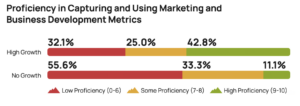
The figure above shows the percentage of firms that have low, some, and high proficiency in capturing and using marketing and BD metrics. Unsurprisingly, High Growth firms outperform Low Growth firms in this area. They hold a 42.8% to 11.1% advantage at the highest level of proficiency. And less than a third of the top-performers are in the low proficiency category. Meanwhile, well over half of the Low Growth firms languish there.
The fastest-growing firms are also more digitally mature than their slower-growing counterparts, giving them a distinct edge in efficiency and productivity.
Conclusion
High Growth firms offer a model for firms that want to achieve faster growth and higher profitability. While we’ve highlighted a few key findings above, there is much more to unpack in the full industry report—including practical advice to put the data to work at your firm. You can learn about and purchase the 2026 High Growth Study, Technology & Software report here.