
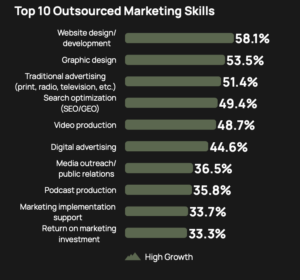
Over the past year, I have covered many features of the most successful firms. Today, I want to discuss one in particular that I haven’t explored in detail before. I’m talking about visual design. Of the skills that high-growth firms outsource most often, it takes the top two spots. And for good reason.
Here’s the data from the 2026 High Growth Study:
When marketing budgets are tight, it’s easy to think of design as a “nice to have.” But in a marketplace filled with look-alike professional services firms, design can play a pivotal role. It can shape perceptions at a variety of touch points, from your website to your business collateral to your pitch decks and proposals. People encounter your visual identity at every stage of the buyer’s journey.
Instead of relying on words alone to persuade and express key brand attributes and benefits, a firm can use design—color, images, layout and typography—to set a tone and help tell its story. By enlisting design as part of its brand strategy, a firm can engage its audience at a raw, emotional level, laying a psychological foundation for a uniquely appealing, powerful brand.
Good design is not just about aesthetics. It is also about differentiation, creating an exciting experience and communicating your firm’s sophistication without using words. When a buyer encounters a well-crafted visual identity, it inspires confidence and signals a high level of credibility and attention to detail.
If your identity looks significantly different from your competitors, your firm immediately stands apart from otherwise similar firms. Color and imagery, in particular, can play a big role in achieving this effect.
Design can also convey your firm’s personality. Are you bold and innovative? Calmly efficient? Confident yet friendly? Fun to work with? The design choices you make can communicate a wide range of attributes and support your positioning.
So much of branding and marketing is about building perceptions. Perceptions that your firm is exceptionally—if not uniquely—qualified to solve a prospective client’s problem. Perceptions that your team will be a perfect fit. Perceptions that you are top experts in your field. Although design can’t communicate these abstract ideas directly, it can create a psychological setting that makes those messages and perceptions plausible and convincing.
In a hypercompetitive marketplace, you need every advantage. And high-quality design provides one more way to capture buyers’ attention and cultivate trust. Best of all, it mostly does its work without any intervention from your team. It can make the messages on your website more compelling, your pitch decks more persuasive and your proposals easier to sign.
The professional services are rife with firms that don’t appreciate the power of design. As a result, buyers have to overcome that hurdle before they can take the next step. (“I’m not encouraged by the look of this website. Hopefully, that’s not a bad sign.”) Inattention to the visual side of your brand just adds unnecessary friction in the selection process.
High-quality design is an investment. But the best-performing firms understand that is money well spent. We are visual beings, and we often draw conclusions unconsciously based on visual cues we encounter. So why take a cue from the market leaders and position your visual brand to deliver the best possible impression?