
We published the 2026 High Growth Study Executive Summary a month and a half ago, and I still can’t stop thinking about this chart:
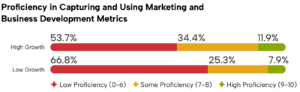
The chart shows what proportion of study participants rated themselves poor, somewhat good or excellent at measuring their various marketing activities and using the results to improve business performance. It compares two categories of professional services firms: 1) high-growth firms, which achieve at least 20% compound growth rate over a three-year period; and 2) low-growth firms, which comprise the rest of the sample.
If there were a sad trombone of charts, this would be it.
Of the top-performing professional services firms, less than 12% rate themselves highly proficient. That’s shockingly low. Even worse, more than half of high-growth firms say they are doing a poor job of collecting and using marketing data.
Not surprisingly, the story is even grimmer for the average firm. Two out of three low-growth firms consider themselves “low proficiency,” while about only one in twelve rate their use of marketing metrics as high.
So what’s going on? Why are even the fastest-growing firms—presumably the most sophisticated marketers—struggling with something seemingly as basic as capturing and using marketing data?
Our research doesn’t provide a definitive answer. But our experience with hundreds of firms—and running our own—provides plenty of clues.
For one thing, marketing generates so much data. Between your CRM, email marketing, social media and website analytics platforms alone there are hundreds of potential data points you could monitor. Add in the many other tools you rely on—from video hosting to SEO and GEO to digital advertising—and things get hairy… well, in a hurry.
Another reason firms struggle with marketing metrics is that pulling data from each platform can be a tedious manual process. The more friction in a system, the more likely it is to break down, and that’s as true of marketing reporting as any other ecosystem. While it is possible to create automated workflows and dashboards, these can be expensive and challenging to set up, and most firms have yet to reach that level of sophistication.
Some of the most valuable metrics aren’t available right out of the box. They have to be configured, a highly technical process often best handled by a skilled expert. If you want to be able to figure out where a piece of new business came from (called attribution), you need to configure your CRM to make that possible. You also need to connect it to all of your digital lead sources, including your website and email marketing platform, so that each touchpoint is accounted for.
Even when marketers and firm leaders have access to the data, they often don’t know what to do with it. Some popular statistics like web traffic might mean less than they seem, while others, such as engagement or conversion metrics, might tell a more useful story. But somebody has to have the training, context and intuition to make sense of that story.
If a channel isn’t producing results, someone has to act on that finding. It can be remarkably hard to abandon an activity that’s become part of the routine. Laziness masquerades as doubt: “What if we’re wrong? Why don’t we just let it run a few months longer.” And a lot of marketing data is less than perfect, which makes decision-making feel risky.
The challenges are many, so how do you escape this situation? If you are in the low proficiency category, don’t aim too high. It’s easy to become overwhelmed. If you can track just a few metrics well, you are likely to improve your position relative to the field.
Which metrics are most important? I can’t give you an easy answer, since any good and honest response will depend on your own business model and growth strategy. Speaking of strategy, that’s the place to start. For instance, how are you hoping to attract the attention of new prospects, or how are you planning to nurture existing ones? You might look for a handful of high-quality metrics that measure your visibility to qualified prospects or quantify your engagement with people already in your database.
Examples of visibility metrics might include the number of new people who visit your blog and spend at least a minute on the page; the number of new registrations for your webinars; or the number of people who clicked on your LinkedIn ad. This just scratches the surface, of course.
Engagement metrics could include your marketing email open rates; number of content bingers (people who consume a high volume of your online content); and consultation requests. Use your imagination to determine your own.
Don’t forget the bottom line impact metrics: key financial and business developments metrics, like revenue growth, closing rate, revenue per lead and client lifetime value. These are the fundamental metrics that your marketing program is designed to drive forward. If these needles aren’t moving, or if they are moving in the wrong direction, there is likely something wrong with your marketing. Of course, external forces can affect these numbers too, so you have to read them in the context of the broader marketplace.
Now, collecting data without taking action is a waste of time. So schedule regular meetings with key stakeholders to evaluate your analytics. The cadence will depend on what you are measuring, but once a month is a good place to start. Ask fundamental questions like, “What are we trying to achieve with this channel?” And, “Is this a blip or a trend?” And, “Have we given this technique enough time and resources to succeed? Or have we stuck with it too long?”
Don’t leave the meeting without a specific action plan based on the findings. It might be as simple as staying the course. Or it might be a decision to drop one technique and reassign its resources to a new or existing technique. If at some point your marketing program isn’t delivering the performance you need, you might decide to reset and start over. Sometimes big problems require big changes.
Mastering marketing metrics isn’t easy. But if you take it slow and smart you’ll be rewarded with remarkably clear insights that you can put to work today.