
‘Tis the season for marketing planning, and many people fear it like the living dead. In part, that’s because people think a marketing plan has to be something complicated and difficult. Nothing could be further from the truth. If anything, it should be simple and straightforward.
That said, it helps to build your plan upon solid ground. That means doing a little background work first.
Understand Your Market and Yourself
Before you even think about tactics and budgets, it can be very useful to take a fresh look at the market landscape. At Hinge, we encourage our clients to do three things:
- Reassess Your Business. Take a look at your firm from 30,000 feet. What are your big-picture business goals for the coming year? Are you trying to enter a new market? Become more profitable? Hit an ambitious revenue goal? Outmaneuver sleepy competitors for new clients? Your marketing goals must be tied directly to these business objectives. This might also be a good time for a classic SWOT analysis (Strengths, Weaknesses, Opportunities, Threats). Try to be as honest as you can—it’s easy to overestimate your advantages. Or work with a marketing partner who will bring the objectivity you need.
- Talk to Your Clients. Most firms think they know their clients, but the reality is often quite different. Our research has shown there’s only a 25% overlap, on average, between the companies a firm thinks it competes against and those that clients and prospects consider its competitors. Yikes! How do you close this gap? By conducting research. Ask your best clients about their biggest challenges, how they find and select firms like yours, and where they go for information. Also ask who they considered, and why they selected your firm. This isn’t just good intel. It’s a goldmine that will tell you exactly where to focus your marketing.
- Figure Out What Makes You You. In a sea of look-alike firms, you have to give buyers a reason to choose you. This is your key differentiator or unique selling proposition. Maybe you specialize in a niche industry or solve a very specific problem. Maybe you’ve developed a groundbreaking new process or technology. Whatever it is, it must be true, provable, and relevant to your audience. Don’t just say you have “the best people”—a claim that anybody can make. Dig deeper to find the thing that only you can claim.
If you don’t have time to do all the due diligence, don’t panic. You can still get a useful, if not entirely complete, read on your situation. Sit down with your leadership team for an hour and walk through the three items above. Remind each other to be as objective as possible.
What Should You Put in Your Plan?
Now it’s time to start building the plan itself. It doesn’t need to be a 100-page document. In fact, short plans are more likely to be put into action. You just need to provide enough detail to guide your team through the coming year. Nor is there a specific format you have to follow. Write it to be easy-to-use and practical. Here are some elements you might want to include:
Target Audience: Who, specifically, are you trying to reach? The more narrowly you can define your audience the better. It’s far easier to market to a single audience that has a defined set of challenges than ten or twenty segments, each with different needs. If your firm is large, however, you likely have multiple audiences. Just be sure you understand what each needs to hear.
Key Messages: Based on your differentiators, what are the core ideas you want to communicate? Craft a simple, powerful “only” statement that captures your unique value.
Strategies & Tactics: How will you reach your audience with your message(s)? Your strategies are the broad strokes (e.g., “become a thought leader in our niche”), and your tactics are the specific actions you’ll take to carry out a strategy (e.g., “publish weekly blog posts, speak at two industry conferences, and launch a quarterly webinar series”). To help you choose activities that actually work, we’ve prepared a list of tactics most favored by the best-performing professional services firms. Don’t worry. You don’t have to use them all. It’s far better to do a small handful of them well.
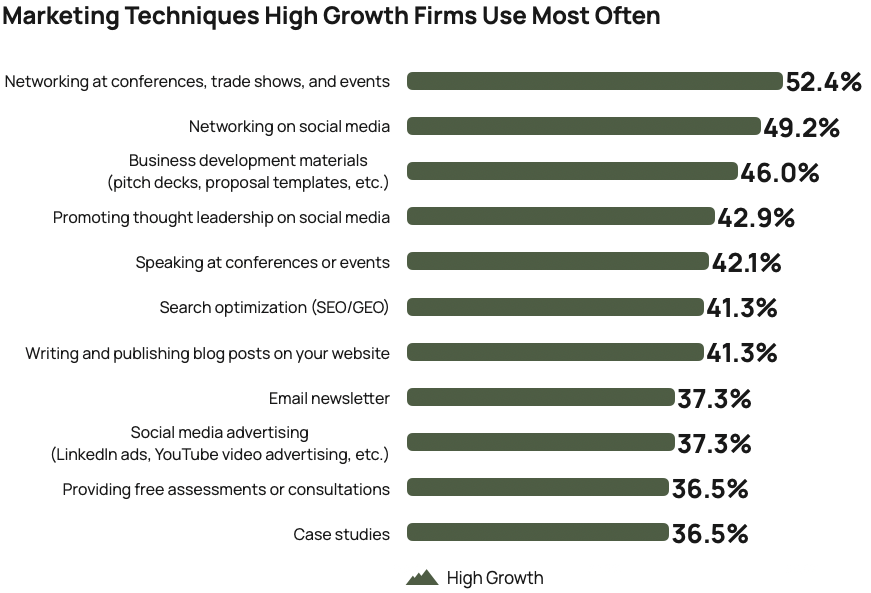
Source: 2026 High Growth Study
Content Marketing: If content marketing, such as blogging and public speaking, is part of your plan—and it should be—create a spreadsheet that plans out each post, speaking engagement and webinar. Get specific. Include titles or topics for each item, keywords (if applicable), who is responsible, internal deadlines and publication or presentation dates. Then hold people accountable for delivering. If your experts don’t have time to write, consider hiring a professional ghost writer to help them.
Budget: What will it cost to execute your plan? Be realistic. High-growth firms, on average, invest 10% of their revenue in marketing (not including salaries), though this number varies by industry. Are you investing enough to get superior results?
Goals & Metrics: How will you know if it’s working? Define specific, measurable goals. Instead of “increase website traffic,” try “increase organic traffic by 15% in the next six months.” Track your progress, measure what matters, and be prepared to adjust or change tactics if they aren’t performing.
If there’s one thing you can count on, it’s this: Not all of your marketing activities will go according to plan. A marketing plan is an educated guess. So expect bumps and adjustments along the way. While you will put your plan in writing, it will change along the way. That’s why it’s a good idea to keep notes that document where things went wrong, how you adjusted and whether those changes moved the needle.
Writing a marketing plan doesn’t have to be like folding a fitted sheet. It can be a fulfilling—even fun—exercise. And one with tremendous upside for your business.